Airbnb hosts spend significant time optimising their photography, writing their listing descriptions, and adjusting their pricing. Most of them are optimising the wrong things.
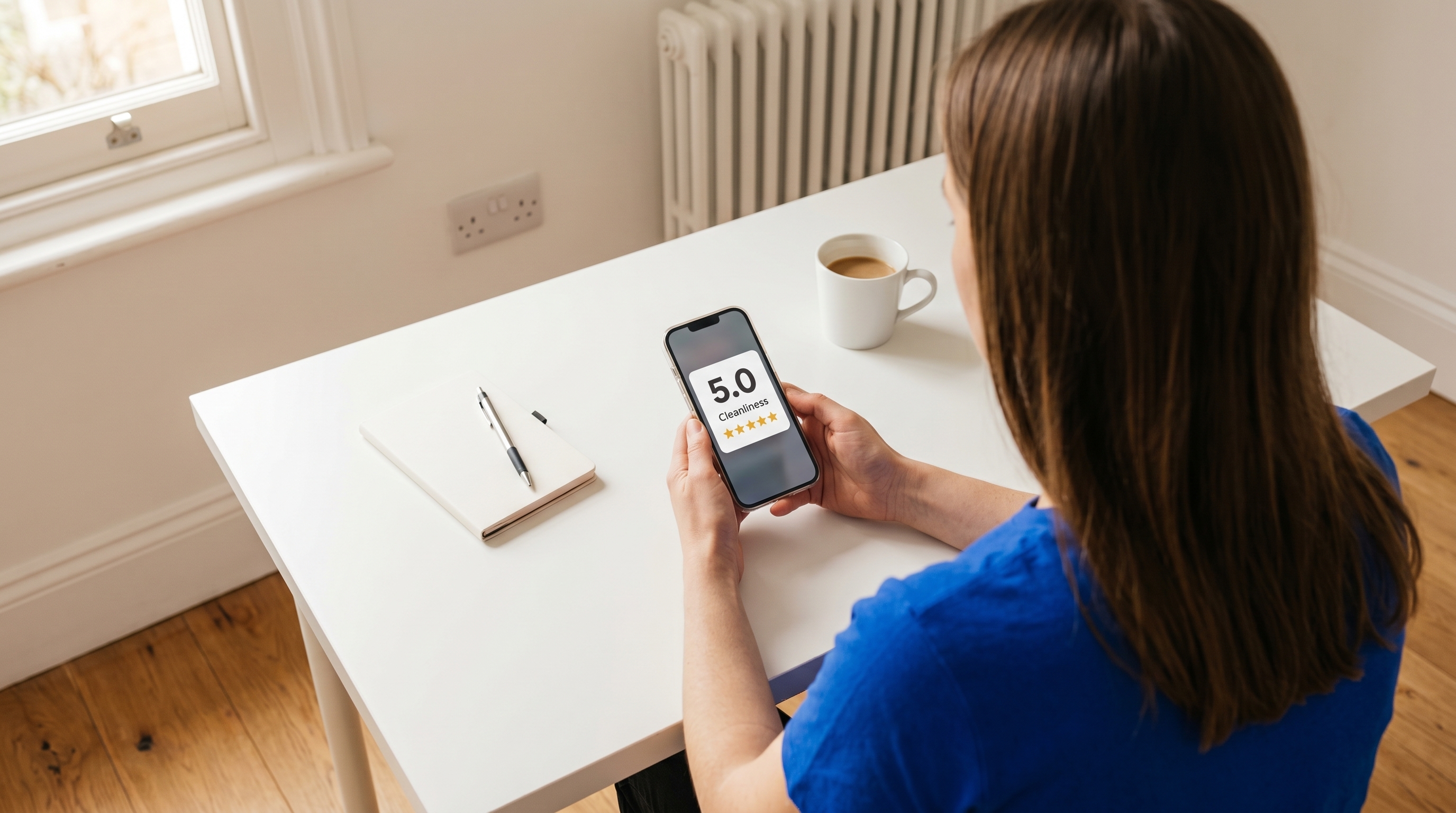
The single most controllable factor in Airbnb's search algorithm, and the one that directly determines whether you maintain Superhost status, is your cleanliness score. Not your overall rating. Not your response rate. Your cleanliness rating specifically.
How Airbnb's Search Algorithm Actually Works
Airbnb does not publish its algorithm, but the ranking signals are well-documented through host community data, Airbnb's own host education materials, and third-party analysis of search result patterns.
The algorithm scores listings on a combination of:
- Guest review scores (weighted by recency)
- Booking conversion rate (how often people who view your listing actually book)
- Response rate and response time
- Calendar availability
- Cancellation history
- Listing quality signals (photo count and quality, description completeness)
Within guest review scores, Airbnb breaks down the overall rating into six sub-categories: cleanliness, accuracy, check-in, communication, location, and value.
Cleanliness carries the highest weight. This is confirmed by Airbnb's own Superhost criteria, which explicitly lists a cleanliness rating threshold as a separate requirement from the overall rating. You can have a 4.9 overall rating and still lose Superhost if your cleanliness score drops below 4.8.
The Maths of a Cleanliness Drop
Here is what the data shows about the impact of cleanliness scores on search position and booking revenue:
A property with a 4.9 overall rating and 4.9 cleanliness typically ranks in the top 15–20% of search results in its market.
Drop the cleanliness score to 4.6 while keeping the overall rating at 4.8, and that same property drops to the 35–50% range, pushed below newer listings and listings with better recent cleanliness scores.
For a Manchester city-centre two-bedroom generating £2,200 per month at 85% occupancy, dropping from the top 20% to the 35–50% range typically reduces occupancy to 65–70%. That is a £330–£440 per month revenue reduction.
The single clean that triggered the 3-star cleanliness review probably cost £65. The margin hit from the review can be ten times that, every month for six months until you accumulate enough 5-star cleanliness reviews to recover.
What Triggers a Bad Cleanliness Review
Guests almost never leave a 3-star cleanliness review because everything was dirty. They leave it because of one specific thing that surprised them. The most common triggers, based on host forum reports and Airbnb's own data:
- Hair in the bathroom: shower, bath, or floor. This is the most commonly cited specific complaint.
- Previous guest's belongings: an item left behind that the cleaner missed
- Kitchen grease or food residue: inside the microwave, on the hob, or on chopping boards
- Musty or stale smell: usually caused by inadequate ventilation after a clean, or a washing machine that has not been cleaned
- Dusty surfaces at eye level: TV unit, top of the fridge, light fittings
None of these are catastrophic cleaning failures. They are details. And they are all preventable with a consistent professional cleaning standard and a proper checklist.
Superhost Status and the Cleanliness Threshold
Airbnb's Superhost criteria are reviewed quarterly. The requirements for 2026 are:
- Completed at least 10 stays in the past year (or 100 nights across 3+ stays)
- Maintained a 90% or higher response rate
- Maintained fewer than 1% cancellations
- Maintained an overall rating of 4.8 or above
- Maintained a cleanliness rating of 4.8 or above
That final criterion is the one most hosts fail on. It is also the one most directly in your control, because it is entirely determined by the quality of your cleaning operation.
Superhost status affects search ranking directly. Airbnb gives Superhost listings a visible badge that increases click-through rate, and the algorithm uses Superhost status as a positive ranking signal. The compound effect of better ranking plus higher click-through is significant: hosts who maintain Superhost status typically earn 20–30% more per year on identical properties compared to non-Superhost listings in the same market.
How to Protect Your Cleanliness Score
Use a professional short-let cleaning service. Domestic cleaners and informal arrangements produce inconsistent results. STR-specialist cleaners work from a defined checklist and know the specific failure points that trigger bad reviews.
Get photo verification of every clean. You cannot verify quality if you are not there. Photo-verified cleaning means you see the completed property before your guest does.
Schedule deep cleans quarterly. A consistent turnover clean maintains the surface. A quarterly deep clean catches the slow accumulation of grout staining, limescale, and under-appliance grime that eventually surfaces in a review.
Act immediately after any 3-star or 4-star cleanliness review. Do not wait for the next bad review to investigate. One 3-star review followed by another is a pattern that is hard to recover from quickly.
Actionable Takeaway
Check your cleanliness sub-score in your Airbnb host dashboard. If it is below 4.8, you are already paying the ranking penalty in reduced search position and lower occupancy. The fix is operational, not cosmetic.
See how CleanHive's photo-verified cleaning protects your score →